
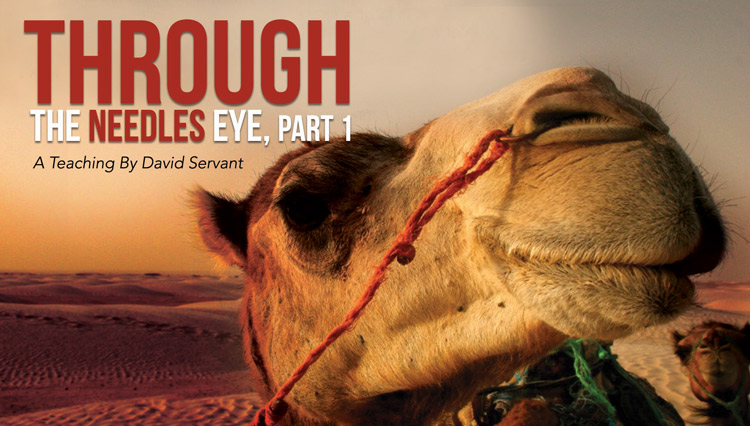
More than a decade ago I wrote a controversial book titled, Through the Needle’s Eye, and subtitled, An Impossible Journey Made Possible by God. Due to the subject matter—biblical stewardship—it was by far the most challenging book I’ve ever written. I did my best to be honest in interpreting what Scripture says, but the problem is, the Bible doesn’t always support what is often taught and believed about stewardship in modern church circles.
So I gritted my teeth as I wrote, knowing that, most likely, my finished product would not end up on the New York Times Best Seller List. In fact, I felt certain that what I was writing would close most every church door that might otherwise be open to my teaching ministry. It was like closing the lid on my own coffin.
Looking back now, it is still painful. Of course, choosing God’s approval over man’s approval often is.
There is a reward, however. For me, part of that reward has been the positive feedback I’ve received from those who dared to read Through the Needle’s Eye with an open mind. Many of those readers have told me of how their lives have been changed.
So it is with similar trepidation—and hope—that I intend to publish the chapters from Through the Needle’s Eye for a season as my monthly e-teachings. This month will only be the Introduction. I pray you will read this first installment, and then make a decision to read the subsequent chapters as we publish them each month.
I can assure you that you will be challenged. In all honesty, however, you could reject half of what I write and still experience some significant lifestyle changes. But more importantly, you could experience some significant eternal changes, because Through the Needle’s Eye is all about laying up treasure in heaven.
When I originally wrote Through the Needle’s Eye, I did my best to make it as easy to swallow as possible. And as I publish this e-teaching version, I’m hoping to do an even better job at that by making some additional edits, remembering that anyone who is willing to even be challenged regarding biblical stewardship is a special and rare person. I hope you are one of them! And now, more than a decade later, I’m even more sympathetic to my readers, as I’ve struggled as much as anyone trying—and often failing—to live up to what I believe is truth. It is impossible to get through the “needle’s eye” without God’s gracious help. May He help us, first of all, be willing to examine our lives honestly in light of His Word. — David
Introduction
Anyone who reads through the Gospels cannot avoid encountering Jesus’ startling and often troubling words about money, possessions and stewardship. He commanded His followers to sell their possessions and give to charity (Luke 12:33). He forbade them to lay up earthly treasures (Matt. 6:19). He told stories about rich people who went to hell (Luke 12:16-20; 16:19-31). He warned that eternal damnation awaited those who don’t help the very poor among His family (Matt. 25:31-46).
What are we to make of these “hard sayings,” as they are commonly called?
Tragically, many within the realm of Christendom, convinced that their salvation is secure by means of a faith that requires no obedience to Christ, simply ignore them. They mistakenly trust in a grace that is foreign to Scripture, one that gives them license to sin. In their minds, Jesus’ commandments serve no higher purpose than to show them their sinfulness, thus motivating them to receive Him as Savior as they continue to reject Him as Lord. Repentance and obedience, they think, are optional.
I’ve exposed these fatally-flawed assumptions in an earlier book titled, The Great Gospel Deception. Jesus and His apostles repeatedly warned that faith without works cannot save and that heaven does not await the unholy. Jesus declared that it is not those who call Him Lord who will be saved, but those who do the will of His Father (Matt. 7:21). Only they are His true brothers (Matt. 12:48-50). Paul taught that those who practice sin, including the greedy and covetous, will not inherit God’s kingdom, even if they profess to believe in Jesus (1 Cor. 6:9-10; Eph. 5:3-5). John declared that only those who keep Jesus’ commandments actually know Him (1 John 2:3-4). The author of the book of Hebrews tells us that without holiness, no one will see the Lord (Heb. 12:14). Jude warned against the heresy of turning God’s grace into a license to sin (Jude 1:4). All of this being so, it is utterly foolish to ignore Jesus’ “hard sayings” about money, possessions and stewardship.
Those who don’t simply ignore Jesus’ difficult statements about stewardship sometimes soften or explain them in such a way that troubled consciences are soothed. How relieving it is to discover “what Jesus must have really meant,” so that we can convince ourselves that we have been, after all, obeying Him right along.
Both of those “solutions” are only temporary at best. Eventually we all must stand before the One who gave those commandments that are so often ignored or modified. And just the fact that we resist what the Lord Jesus plainly said indicates we have a problem right now that needs to be fixed.
Let’s face it, no one likes to think that God might appraise them as being selfish, materialistic, greedy, deceived—or worse, disqualified for heaven. We’ll do just about anything to avoid those kinds of thoughts, including believe lies. The only other alternative—taking what Jesus said honestly—is just too difficult.
God, of course, is well aware of the difficulty I’ve just described. It was Jesus who said it was easier for a camel to go through the eye of a needle than for a rich person to be saved (Matt. 19:24-25). Even if you are clinging to the legend of an alleged “Needle Gate” in Jerusalem where camels had to unload before entering, the unavoidable conclusion is still the same—everything must be shed or you don’t get in. I’m so thankful that Jesus offered some hope to His despairing disciples who, after hearing His camel and needle analogy, understandably asked, “Then who can be saved?” He responded, “With men it is impossible, but not with God; for all things are possible with God” (Mark 10:26-27). So there is hope for us—but only with God’s help.
Obviously, Jesus did not mean that God would make the impossible possible by changing His mind and lowering His requirements for rich people to enter His kingdom. Rather, He would make the impossible possible by helping rich people to meet His requirements.
It is also obvious that God doesn’t help rich people without their cooperation. Jesus didn’t stop the rich, young ruler from sadly walking away. God isn’t in the business of making holy robots.
God helps us by first helping us to face up to what Jesus plainly said. He exposes the lies we’ve believed in light of His Word. He makes us feel guilty (as unpopular as that idea is to modern ears).
Then God helps us change our desires and repent. He turns greedy people into generous people. He helps us to do what is not possible to do without Him.
It is nothing short of a miracle, and it happens to a minority of people. But you can be one of them. You must be prepared, however, to let God help you His way and to cooperate with His help.
My Personal Struggle
I think I can safely say that you will be challenged by what you are about to read in the chapters that follow, but being challenged is part of the process of all spiritual growth. You must understand that there is no other way. May I add that I can certainly sympathize with you. As I’ve personally faced up to what Jesus taught, I’ve often felt like a camel squeezing through the eye of a needle. For many years as a pastor, I lived and taught in contradiction to much of what I’ve written in this book. But God helped me, first by showing me how I had been ignoring numerous scriptures and twisting the clear meaning of many others.
He also showed me my selfishness. I had been a poor steward of His money with which I had been entrusted, and I was not ready to stand before Him to give an account. It wasn’t an easy pill to swallow, but I’m so glad God opened my eyes.
Since then, and after conversing with many people on this subject, I’ve become even more convinced that none of us can honestly receive what Jesus said about money, possessions and stewardship unless God Himself does a work in our hearts. If, however, our hearts are not open to God’s work, no amount of Scripture or logic will change us. We will remain willfully deceived.
“But I’m certain I’m not deceived!” you may claim. But let us face up to the undeniable fact that every deceived person would claim that very thing. If deceived people knew they were deceived, they wouldn’t be deceived. That is why it is imperative that we adopt a sincere, humble attitude that says, “I may be deceived, and if I am, I pray that God will help me to see it.” Otherwise, there is little hope that we will accept what Jesus taught.
The Bible declares that God resists the proud (1 Pet. 5:5), and as long as we are not open to self-examination and correction, our pride causes God to resist us. Scripture also teaches, however, that God gives grace to the humble (1 Pet. 5:5). As we sincerely humble ourselves and ask God to show us the truth—to open our eyes to any lies we’ve believed and to reveal if we’re displeasing to Him in any way—He will pour His grace upon us. God hides truth from those who consider themselves “wise and intelligent,” but He opens the eyes of “babes” (Luke 10:21).
The Goodness of Guilt
So the very first step through the needle’s eye is made by determining to face up to what Jesus plainly taught. We must be willing to examine ourselves in the light of His words, and we must be willing to accept guilt if we find ourselves falling short. We must not perceive guilt to be an adversary, as it is often made out to be. Guilt, in fact, is the great catalyst of spiritual progress, because we don’t change unless we are motivated to change. Repentance is always preceded by guilt. That is God’s way, and the only way that He can even begin to get camels through needles.
Guilt is the simple recognition that we are not pleasing God.
It is indisputable that the only people whom God doesn’t want to feel guilty are those who aren’t guilty. And the only people who are not guilty in God’s eyes are those who are not sinning, or those who have sinned, repented, and been forgiven by Him. If one repeats his sin after he has received God’s forgiveness, he is once again guilty, and he should feel guilty. It’s just that simple.
Scripture admonishes us, “My son, do not reject the discipline of the Lord, or loathe His reproof” (Prov. 3:11). What is guilt but God’s reproof? We should therefore not reject it, but welcome it, embrace it, and allow it to work God’s remedy in us, which is our repentance and obedience.
On the other hand, Scripture declares that fools spurn God’s reproof (Prov. 1:22-30). Foolish indeed are those who are adverse to guilt or any teaching that makes people feel guilty. If one is adverse toward guilt, he is adverse toward God. Amazingly, many such people claim to be Christians.
The Difference Between Conviction and Condemnation
Perhaps the most common objection to any teaching that induces guilt is the accusation that is it is “condemning.” But that objection is often without basis, and what is so often rejected as “condemning” ought to be embraced as “convicting.” The primary difference between condemnation and conviction is the element of hope. Condemnation is void of hope. Conviction is absolutely bursting with it. The whole purpose of guilt is to motivate us to repent; thus the very concept of guilt implies that forgiveness is available. Praise God! But those who don’t yield to the conviction awakened by guilt do not experience God’s forgiveness.
Another difference between condemnation and conviction is the underlying motive of the person who is trying to either condemn or convict. Condemnation often stems from a motive of justice or even hatred, whereas conviction is born from a motivation of love and mercy.
Nothing that follows in this book is intended to be condemning, although much is likely to be convicting. Anyone who claims otherwise is hiding behind a smokescreen because he feels convicted and doesn’t want to change. I write from a motivation of love, as one who once was completely brainwashed (“brain dirtied” would describe it better) by beliefs that contradicted Christ’s commandments. I’ve also wrestled with the conviction that every reader will face. It hasn’t been easy for me and it won’t be easy for you. But to keep silent now would be criminal, because God ultimately does condemn those who resist His conviction.
When guilt is based on the unconfessed, unforgiven transgression of God’s will, guilt is a very good thing. It is a means of God’s communication. It is an indication of His love. Please, as you read, don’t resist His love for you. Don’t resist what can motivate you to change. We can deal with our guilt either by confession and repentance or by self-justification. Confession and repentance reveal a humble heart that chooses to believe the truth; attempting to justify our actions reveals a proud heart that willfully believes a lie. If we believe in and love Jesus, we will not be adverse to what He plainly said. He declared, “If you love Me, you will keep My commandments” (John 14:15). It’s just that simple.
So let us begin with a sincere prayer on our knees, or better, on our faces. Pray for God’s help to get through the needle’s eye. Then let us begin to consider honestly what Jesus taught about money, possessions and stewardship. You are about to begin a journey that leads to true joy. — David